
News
How to Choose Right Material Handling Equipment
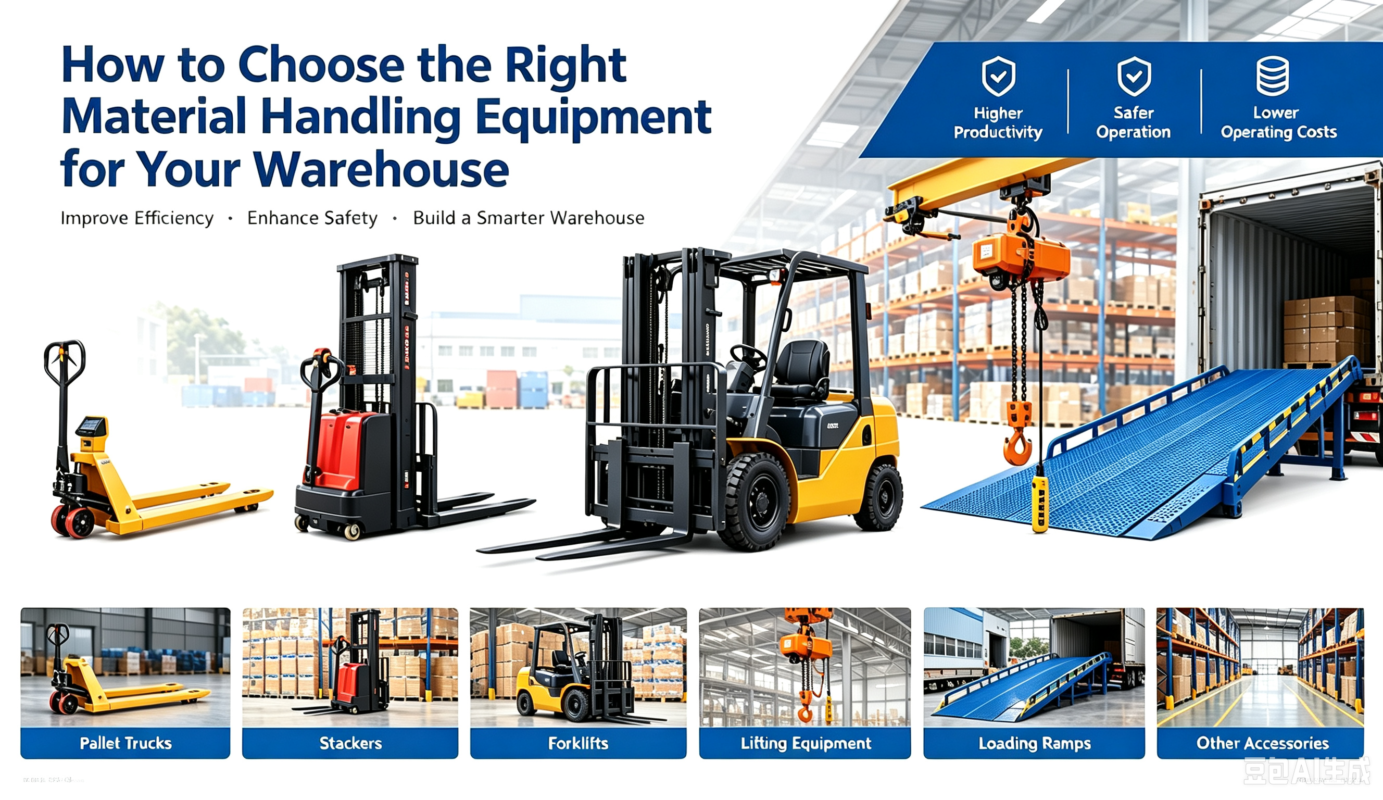
How to Choose the Right Material Handling Equipment for Your Warehouse
Efficient material handling is essential for modern warehouses, distribution centers, factories, logistics companies, and industrial facilities. Choosing the right material handling equipment can help businesses improve productivity, reduce manual labor, optimize warehouse space, and create a safer working environment.
With many types of warehouse equipment available, including pallet trucks, stackers, forklifts, lifting equipment, warehouse ramps, and electric handling equipment, selecting the right solution requires careful consideration of your application, load capacity, working environment, and operating requirements.
Why Is Material Handling Equipment Important?
Material handling equipment plays an important role in the movement, lifting, loading, unloading, and storage of goods.
Manual handling can become inefficient when warehouses deal with heavy pallets, frequent transportation, or high-volume operations. The right equipment can make daily operations faster and more reliable while reducing unnecessary physical effort.
For example, a pallet truck can be used for short-distance pallet movement, while a stacker is more suitable for lifting pallets to higher storage levels. For heavier loads and more demanding applications, forklifts and other lifting equipment may provide a more efficient solution.
1. Pallet Trucks for Short-Distance Material Movement
Pallet trucks are among the most commonly used pieces of warehouse handling equipment.
They are designed to move palletized goods over short distances and are particularly useful in warehouses, supermarkets, factories, logistics centers, and loading areas.
Depending on the application, customers can choose between manual pallet trucks, electric pallet trucks, and pallet trucks with weighing scales.
When selecting a pallet truck, important factors include:
- Load capacity
- Fork length and width
- Overall dimensions
- Wheel material
- Lifting height
- Operating environment
- Manual or electric operation
For businesses that frequently move pallets between storage areas and loading zones, choosing a pallet truck with the correct specifications can significantly improve handling efficiency.
2. Stackers for Vertical Warehouse Storage
When warehouse space is limited, making better use of vertical storage space becomes increasingly important.
Warehouse stackers are designed to lift and position pallets at different heights. They are suitable for warehouses, workshops, distribution centers, and other indoor material handling applications.
Different applications may require different stacker configurations, including:
- Manual stackers
- Semi-electric stackers
- Full-electric stackers
- Different lifting heights
- Different load capacities
- Adjustable fork configurations
Before purchasing a stacker, it is important to consider the required lifting height, maximum load, aisle width, pallet dimensions, and frequency of operation.
3. Forklifts for Heavy-Duty Material Handling
Forklifts are widely used in warehouses, factories, construction sites, logistics centers, ports, and industrial facilities.
Compared with pallet trucks and stackers, forklifts generally provide greater lifting capacity and are suitable for handling heavier loads over longer distances.
When choosing a forklift, businesses should consider:
- Rated lifting capacity
- Maximum lifting height
- Fuel or power type
- Mast configuration
- Fork dimensions
- Turning radius
- Tire type
- Indoor or outdoor working conditions
For indoor warehouses, electric forklifts can be an attractive option because of their low emissions and relatively quiet operation. For outdoor and heavy-duty applications, internal combustion forklifts may be more suitable depending on the operating environment.
4. Lifting Equipment for Industrial Applications
In addition to warehouse transportation equipment, many industrial applications require dedicated lifting equipment.
Electric chain hoists, lifting slings, shackles, lifting chains, and other lifting accessories can be used for lifting and positioning loads in workshops, warehouses, construction projects, maintenance operations, and industrial facilities.
Selecting lifting equipment should always be based on the actual load, lifting method, working conditions, and required safety specifications.
The working load limit and equipment specifications should be checked carefully before use.
5. Warehouse Ramps for Loading and Unloading
Loading and unloading can become a major challenge when there is a height difference between a warehouse floor and a truck or container.
A suitable warehouse loading ramp can provide a practical solution for moving forklifts, pallet trucks, and other handling equipment between different working levels.
Depending on the application, ramps can be selected according to:
- Maximum load capacity
- Ramp length
- Platform height
- Ramp width
- Surface design
- Mobility requirements
- Forklift compatibility
For logistics companies and warehouses with frequent loading and unloading operations, choosing the correct ramp can help improve operational efficiency.
How to Choose the Right Material Handling Equipment
There is no single piece of equipment that is suitable for every warehouse.
Before making a purchase decision, consider the following factors.
Load Capacity
Determine the maximum weight of the goods that need to be handled. Equipment should have an appropriate rated capacity for the application.
Lifting Height
If goods need to be stored on racks or elevated platforms, the required lifting height should be determined before selecting a stacker or forklift.
Working Environment
Consider whether the equipment will be used indoors, outdoors, on smooth warehouse floors, uneven surfaces, construction sites, or other demanding environments.
Frequency of Use
For occasional handling, manual equipment may be sufficient. For high-frequency warehouse operations, electric equipment can provide greater efficiency and reduce operator effort.
Warehouse Space
Aisle width, turning radius, pallet size, and available storage space are important factors when choosing forklifts and stackers.
Maintenance and Spare Parts
Reliable equipment is only part of a successful material handling solution. Easy access to spare parts, maintenance support, and technical assistance can also help reduce downtime.
One-Stop Material Handling Equipment Solutions
For companies purchasing multiple types of equipment, working with a professional material handling equipment supplier can simplify sourcing and communication.
Instead of purchasing pallet trucks, stackers, forklifts, lifting equipment, ramps, and related accessories from different suppliers, businesses can evaluate their requirements and develop a more complete equipment solution.
A professional supplier should be able to provide suitable equipment according to the customer’s application, load requirements, working environment, and budget.
Conclusion
Choosing the right material handling equipment can have a direct impact on warehouse productivity, operating efficiency, workplace safety, and long-term equipment costs.
From pallet trucks and warehouse stackers to forklifts, lifting equipment, and loading ramps, each type of equipment has a specific application. Understanding your actual handling requirements is the first step toward selecting the right solution.
If you are looking for reliable material handling equipment, warehouse equipment, forklifts, stackers, lifting equipment, or industrial machinery, a professional supplier can help you compare different options and develop a suitable solution for your application.
The right equipment is not simply about moving a load — it is about creating a more efficient, safer, and better-organized operation.