News
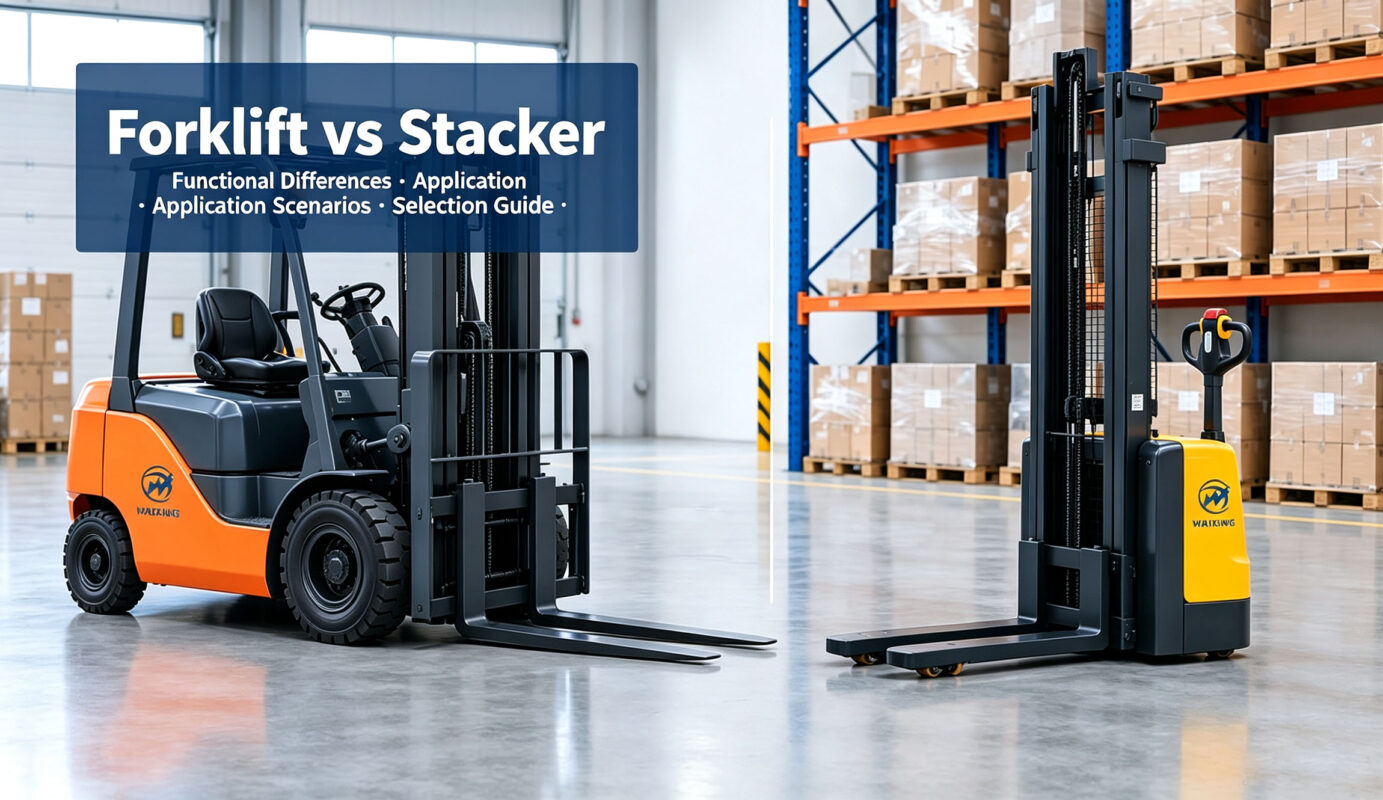
Forklift vs. Stacker Which Equipment Is Right for Your Application
Understanding the Right Application for Each
Choosing the right material handling equipment is an important decision for warehouses, distribution centers, manufacturing facilities, and logistics operations. Among the most commonly used machines are forklifts and stackers.
Although both types of equipment are designed to lift and move loads, they are not intended for exactly the same applications.
Understanding the differences between a forklift and a stacker can help warehouse operators select equipment that matches their working environment, load requirements, and daily handling needs.
What Is a Forklift?
A forklift is a versatile material handling machine designed to lift, transport, and position heavy loads.
Forklifts are commonly used in warehouses, factories, logistics centers, construction sites, ports, and outdoor working environments.
Depending on the model, forklifts can handle different load capacities and lifting heights. They are particularly suitable for applications where loads need to be transported over longer distances or where higher lifting capacity is required.
Common forklift applications include:
- Moving pallets across warehouses
- Loading and unloading trucks
- Handling heavy materials
- Transporting goods over longer distances
- Stacking pallets at medium or high heights
- Outdoor material handling
- Loading and unloading containers
Forklifts are available in different configurations, including electric, diesel, and LPG models, allowing users to select a suitable power source for their operating environment.
What Is a Stacker?
A stacker is a more compact type of warehouse material handling equipment designed primarily for lifting and stacking pallets.
Stackers are commonly used for indoor warehouse operations where maneuverability, compact dimensions, and efficient pallet stacking are important.
Compared with many conventional forklifts, stackers generally have a smaller operating footprint, making them suitable for narrower aisles and areas with limited space.
Typical stacker applications include:
- Pallet stacking
- Moving pallets over short distances
- Loading and unloading pallets
- Organizing warehouse storage areas
- Working in narrow aisles
- Light to medium-duty warehouse operations
Depending on the design, stackers may be manually operated, semi-electric, or fully electric.
Forklift vs. Stacker: Key Differences
While forklifts and stackers can perform some similar tasks, their strengths are different.
| Feature | Forklift | Stacker |
|---|---|---|
| Main application | Transporting and lifting loads | Lifting and stacking pallets |
| Load capacity | Generally higher | Generally lower |
| Operating area | Indoor and outdoor, depending on model | Mainly indoor |
| Maneuverability | Good | Excellent in compact areas |
| Aisle requirements | Usually wider | Suitable for narrower aisles |
| Travel distance | Suitable for longer distances | Best for short-distance movement |
| Lifting requirements | Medium to high | Mainly warehouse stacking |
| Typical operation | More intensive material handling | Warehouse storage and pallet handling |
| Power options | Electric, diesel, LPG, etc. | Manual, semi-electric, electric |
The actual specifications vary by equipment model, so users should always evaluate the machine according to the specific application